


Introduction
Artificial Intelligence (AI) and Machine Learning (ML) are two of the most discussed technologies in today’s digital world. They are often mentioned together, leading many people to believe they mean the same thing. While they are closely related, AI and Machine Learning are not identical. Machine Learning is a subset of Artificial Intelligence, and both technologies work together to create intelligent systems capable of solving complex problems.
From recommendation systems on streaming platforms to fraud detection in banking and autonomous vehicles, AI and Machine Learning are transforming industries worldwide. Understanding the difference between these technologies helps businesses, students, developers, and professionals make better decisions about adopting and using AI-powered solutions.
This article explains the differences between AI and Machine Learning, how they work, their applications, advantages, challenges, and future potential.
What Is Artificial Intelligence?
Artificial Intelligence is a branch of computer science that focuses on creating machines capable of performing tasks that normally require human intelligence.
These tasks include:
- Learning
- Reasoning
- Problem-solving
- Decision-making
- Understanding language
- Recognizing images
- Speech recognition
- Planning
AI aims to simulate human intelligence so that computers can perform complex tasks with minimal human intervention.
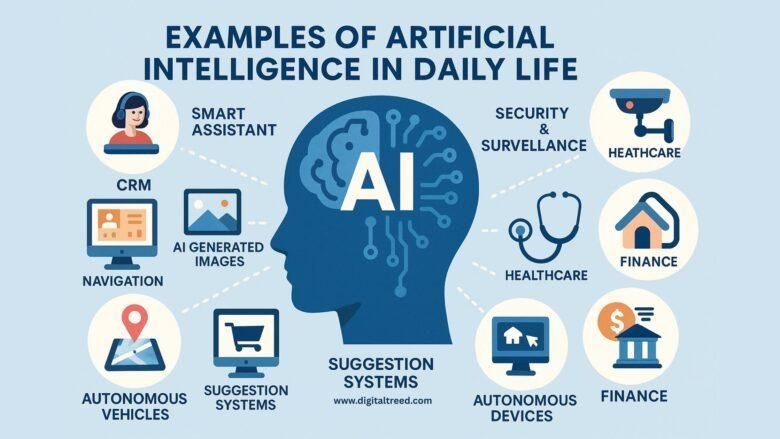
Examples of Artificial Intelligence include:
- Virtual assistants
- Self-driving cars
- Smart home devices
- Medical diagnosis systems
- Customer service chatbots
- Facial recognition systems
What Is Machine Learning?
Machine Learning is a subset of Artificial Intelligence that enables computers to learn from data without being explicitly programmed for every task.
Instead of relying on fixed rules, Machine Learning algorithms identify patterns in data and use those patterns to make predictions or decisions.
The more quality data a Machine Learning model receives, the more accurate it becomes over time.
Examples include:
- Email spam detection
- Product recommendations
- Movie suggestions
- Fraud detection
- Credit scoring
- Predictive analytics
Relationship Between AI and Machine Learning
Artificial Intelligence is the broader concept of creating intelligent systems.
Machine Learning is one of the methods used to achieve Artificial Intelligence.
In simple terms:
Artificial Intelligence → Large Field
Machine Learning → One Technology Inside AI
Not every AI system uses Machine Learning, but many modern AI applications depend on it.
Key Differences Between AI and Machine Learning
| Artificial Intelligence | Machine Learning |
|---|---|
| Broad field of computer science | Subset of AI |
| Focuses on intelligent behavior | Focuses on learning from data |
| Can use rules or learning models | Always relies on data-driven learning |
| Goal is human-like intelligence | Goal is accurate prediction |
| Includes reasoning and planning | Focuses mainly on pattern recognition |
| May not require training data | Requires training datasets |
How Artificial Intelligence Works
Artificial Intelligence combines several technologies.
The basic process includes:
- Collect data
- Process information
- Analyze patterns
- Make decisions
- Learn from results
- Improve performance
AI often integrates:
- Machine Learning
- Deep Learning
- Computer Vision
- Natural Language Processing
- Robotics
- Expert Systems
How Machine Learning Works
Machine Learning follows a structured process.
Step 1: Data Collection
Large datasets are gathered from various sources.
Examples:
- Images
- Videos
- Customer records
- Financial transactions
- Medical reports
Step 2: Data Preparation
The collected data is cleaned and organized.
This includes:
- Removing duplicates
- Correcting errors
- Labeling information
- Standardizing formats
Step 3: Training
Algorithms learn from the prepared data by identifying patterns.
Step 4: Testing
The model is tested using new data to measure accuracy.
Step 5: Prediction
Once trained, the model predicts future outcomes using unseen data.
Types of Machine Learning
Machine Learning has three major categories.
Supervised Learning
The model learns using labeled data where the correct answers are already known.
Examples:
- House price prediction
- Email spam detection
- Credit risk assessment
Unsupervised Learning
The model discovers hidden patterns without labeled data.
Examples:
- Customer segmentation
- Market analysis
- Recommendation systems
Reinforcement Learning
The system learns through rewards and penalties while interacting with an environment.
Examples:
- Robotics
- Game playing
- Self-driving vehicles
Real-World Applications of Artificial Intelligence
AI is used across many industries.
Healthcare
- Disease diagnosis
- Medical imaging
- Drug discovery
- Patient monitoring
Finance
- Fraud detection
- Investment analysis
- Loan approvals
- Customer service
Education
- Personalized learning
- Virtual tutors
- Automated grading
Transportation
- Traffic prediction
- Autonomous vehicles
- Route optimization
Manufacturing
- Predictive maintenance
- Quality control
- Factory automation
Real-World Applications of Machine Learning
Machine Learning powers many everyday services.
Examples include:
- Netflix recommendations
- YouTube suggestions
- Amazon product recommendations
- Google Search rankings
- Voice recognition
- Face recognition
- Fraud detection
- Medical diagnosis
- Predictive maintenance
- Stock market analysis
Advantages of Artificial Intelligence
AI provides numerous benefits.
Increased Efficiency
Automates repetitive work.
Better Decision Making
Processes huge amounts of information quickly.
Improved Customer Service
Provides instant responses through AI chatbots.
Reduced Errors
Minimizes human mistakes in repetitive tasks.
Faster Problem Solving
Analyzes complex situations within seconds.
Advantages of Machine Learning
Machine Learning offers additional benefits.
Continuous Improvement
Models become more accurate with additional data.
Pattern Recognition
Identifies relationships humans may overlook.
Predictive Analysis
Forecasts future outcomes based on historical data.
Automation
Reduces manual work.
Scalability
Processes millions of records efficiently.
Challenges of Artificial Intelligence
Although AI is powerful, several challenges remain.
- Privacy concerns
- Ethical issues
- High implementation costs
- Data security
- Bias in algorithms
- Lack of transparency
Challenges of Machine Learning
Machine Learning also has limitations.
- Requires large datasets
- Poor-quality data reduces accuracy
- High computing requirements
- Difficult model interpretation
- Risk of overfitting
- Ongoing maintenance
AI and Machine Learning in Business
Businesses use these technologies to improve operations.
Common applications include:
- Customer support automation
- Inventory management
- Sales forecasting
- Marketing personalization
- Fraud detection
- Supply chain optimization
- Predictive maintenance
- Financial analysis
Companies adopting AI often improve productivity while reducing operational costs.
Future of AI and Machine Learning
Both technologies continue evolving rapidly.
Future developments may include:
- Smarter virtual assistants
- Improved healthcare diagnostics
- Fully autonomous transportation
- Advanced robotics
- Personalized education
- Better cybersecurity
- Faster scientific discoveries
- More efficient manufacturing
Machine Learning will remain one of the primary technologies driving future AI innovations.
Which Technology Should You Learn?
For beginners, learning Artificial Intelligence concepts provides a broad understanding of intelligent systems.
Machine Learning is an excellent next step for those interested in programming, data science, and predictive analytics.
Useful skills include:
- Python programming
- Statistics
- Mathematics
- Data analysis
- Deep Learning
- Cloud computing
- SQL
- Data visualization
These skills provide a strong foundation for careers in AI and Machine Learning.
Frequently Asked Questions
Is Artificial Intelligence the same as Machine Learning?
No. Artificial Intelligence is the broader field, while Machine Learning is a subset of AI that focuses on learning from data.
Which came first?
Artificial Intelligence was introduced before Machine Learning. Machine Learning later became one of the most successful approaches for building intelligent systems.
Does every AI system use Machine Learning?
No. Some AI systems rely on predefined rules instead of learning from data.
Can Machine Learning exist without AI?
Machine Learning is generally considered a branch of Artificial Intelligence, although it can be studied independently as a data analysis technique.
Which is better to learn first?
Most beginners start with Artificial Intelligence fundamentals before moving to Machine Learning concepts and programming.
Conclusion
Artificial Intelligence and Machine Learning are closely connected but serve different purposes. Artificial Intelligence is the broad science of creating machines that can perform tasks requiring human intelligence, while Machine Learning is a specialized branch of AI that enables computers to learn from data and improve their performance without explicit programming. Together, these technologies power many of the intelligent systems people use every day, from recommendation engines and virtual assistants to fraud detection and medical diagnostics. As industries continue adopting AI-driven solutions, understanding the relationship between AI and Machine Learning becomes increasingly valuable for students, professionals, businesses, and technology enthusiasts. By learning these concepts today, individuals can prepare for a future where intelligent systems play an even greater role in innovation, productivity, and decision-making.







Leave a Reply