

Introduction
Artificial Intelligence (AI) is transforming the way people live, work, communicate, and solve problems. From voice assistants on smartphones to recommendation systems on streaming platforms, AI has become an integral part of daily life. Businesses use AI to automate repetitive tasks, improve customer experiences, analyze vast amounts of data, and make informed decisions faster than ever before.
The rapid growth of AI has created new opportunities across industries such as healthcare, education, finance, transportation, manufacturing, agriculture, and entertainment. As technology continues to advance, understanding what artificial intelligence is and how it works has become increasingly important for students, professionals, and business owners alike.
This guide explains the fundamentals of artificial intelligence, how it operates, its different types, real-world applications, benefits, challenges, and future potential.
What Is Artificial Intelligence?
Artificial Intelligence is a branch of computer science focused on developing machines and software capable of performing tasks that typically require human intelligence. These tasks include learning from experience, recognizing speech, understanding language, solving problems, making decisions, identifying images, and predicting outcomes.
Unlike traditional computer programs that follow fixed instructions, AI systems can analyze data, identify patterns, and improve their performance over time. This ability to learn makes AI more flexible and capable of handling complex problems.
Simply put, artificial intelligence enables computers to think, learn, and make decisions in ways that resemble human intelligence.
How Does Artificial Intelligence Work?
Artificial intelligence works by combining large amounts of data, powerful algorithms, and advanced computing systems. AI learns from information rather than relying only on manually programmed instructions.
The basic AI workflow includes several steps.
1. Data Collection
Every AI system begins with data. This data may include:
- Images
- Videos
- Text
- Audio recordings
- Customer information
- Medical records
- Financial transactions
- Sensor data
The quality and quantity of data significantly affect AI performance.
2. Data Preparation
Collected data is cleaned and organized before training begins.
This process involves:
- Removing duplicate records
- Correcting errors
- Filling missing values
- Labeling information
- Formatting datasets
Clean data improves model accuracy.
3. Model Training
Developers use algorithms to train AI models.
During training, the system analyzes thousands or even millions of examples until it recognizes patterns and relationships within the data.
For example, an AI trained to recognize cats will analyze thousands of cat images until it learns common characteristics.
4. Testing
After training, developers test the AI using new data that it has never seen before.
Testing measures:
- Accuracy
- Precision
- Speed
- Reliability
If the results are poor, developers improve the model by providing additional data or adjusting the algorithm.
5. Prediction and Decision Making
Once trained successfully, AI can make predictions or decisions.
Examples include:
- Recommending movies
- Detecting fraud
- Translating languages
- Recognizing faces
- Predicting weather
- Diagnosing diseases
6. Continuous Learning
Modern AI systems improve continuously as they process new information.
This ongoing learning allows AI to become more accurate over time.
Types of Artificial Intelligence
Artificial intelligence is generally divided into three major categories.
Narrow AI
Narrow AI performs a specific task.
Examples include:
- Voice assistants
- Spam filters
- Facial recognition
- Navigation systems
- Recommendation engines
Nearly all AI applications available today belong to this category.
General AI
General AI refers to machines capable of performing any intellectual task that humans can perform.
Although researchers continue working toward this goal, General AI does not yet exist.
Super AI
Super AI is a theoretical concept describing machines that surpass human intelligence in every field.
This remains a topic of future research and discussion.
Technologies Behind Artificial Intelligence
Several technologies make AI possible.
Machine Learning
Machine Learning allows computers to learn from data without explicit programming.
It powers:
- Recommendation systems
- Fraud detection
- Predictive analytics
- Customer behavior analysis
Deep Learning
Deep Learning uses artificial neural networks inspired by the human brain.
Applications include:
- Speech recognition
- Image classification
- Self-driving cars
- Medical imaging
Natural Language Processing (NLP)
NLP enables computers to understand and generate human language.
Examples include:
- Chatbots
- Language translation
- Voice assistants
- Text summarization
Computer Vision
Computer Vision helps machines understand visual information.
Common applications include:
- Facial recognition
- Object detection
- Medical image analysis
- Autonomous vehicles
Robotics
Robotics combines AI with mechanical systems to perform physical tasks.
Examples include:
- Manufacturing robots
- Delivery robots
- Surgical robots
- Warehouse automation
Real-Life Applications of Artificial Intelligence
Artificial intelligence is already part of everyday life.
Healthcare
AI assists doctors by:
- Detecting diseases
- Reading medical images
- Monitoring patients
- Discovering new medicines
- Supporting personalized treatment plans
Education
Educational platforms use AI to:
- Personalize learning
- Grade assignments
- Recommend study materials
- Provide virtual tutoring
Finance
Banks use AI for:
- Fraud detection
- Credit scoring
- Risk assessment
- Investment analysis
- Customer support
Retail
Retail businesses use AI to:
- Recommend products
- Manage inventory
- Forecast demand
- Improve customer service
Transportation
AI supports:
- Route optimization
- Traffic prediction
- Driver assistance
- Autonomous vehicles
Manufacturing
Factories use AI for:
- Quality inspection
- Predictive maintenance
- Process automation
- Production planning
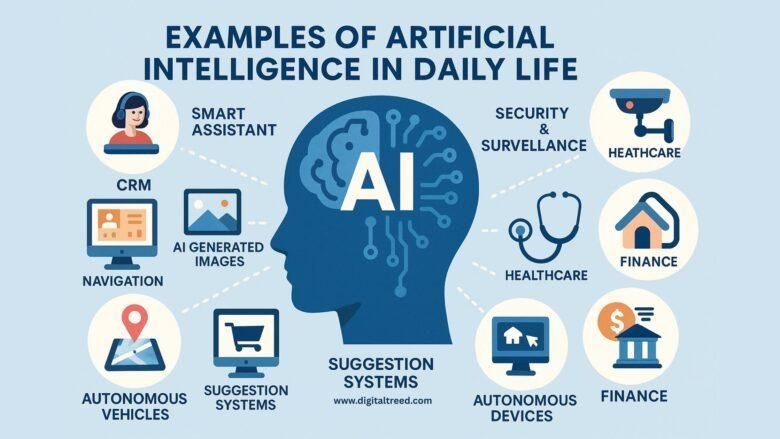
Everyday Examples of AI
Many people use AI without realizing it.
Examples include:
- Google Search
- Voice assistants
- Netflix recommendations
- YouTube suggestions
- Online shopping recommendations
- Email spam filters
- GPS navigation
- Language translation apps
- Smart home devices
- Social media feeds
Advantages of Artificial Intelligence
AI offers numerous benefits across industries.
Increased Productivity
Automation allows businesses to complete repetitive tasks faster.
Better Decision Making
AI analyzes massive datasets and provides valuable insights.
Reduced Errors
Machines perform repetitive tasks with greater consistency than humans.
Cost Savings
Automation reduces labor costs and improves operational efficiency.
Improved Customer Experience
AI-powered chatbots provide instant customer support around the clock.
Faster Data Analysis
AI processes millions of records within seconds.
Personalized Services
AI recommends products, movies, music, and content based on user preferences.
Challenges of Artificial Intelligence
Despite its advantages, AI also presents several challenges.
Privacy Concerns
AI systems often require large amounts of personal data.
Security Risks
Cybercriminals may attempt to exploit AI systems.
Bias
Poor-quality training data can produce unfair or inaccurate results.
Job Automation
Some repetitive jobs may become automated, requiring workers to develop new skills.
High Development Costs
Building advanced AI systems requires significant investment.
Ethical Issues
Organizations must ensure AI systems are transparent, fair, and responsible.
AI vs Traditional Programming
Traditional software follows predefined instructions written by programmers.
AI software learns from data and adapts over time.
Traditional Programming:
- Fixed rules
- Manual updates
- Limited flexibility
Artificial Intelligence:
- Learns from experience
- Improves with new data
- Makes predictions
- Handles complex tasks
Future of Artificial Intelligence
Artificial intelligence continues to evolve rapidly.
Future developments may include:
- Smarter virtual assistants
- More accurate medical diagnosis
- Fully autonomous transportation
- Advanced robotics
- Personalized education
- Improved cybersecurity
- Faster scientific discoveries
- Sustainable agriculture solutions
Businesses worldwide continue investing heavily in AI because it offers significant opportunities for innovation and efficiency.
Tips for Learning Artificial Intelligence
If you want to understand AI better, consider learning:
- Python programming
- Machine Learning fundamentals
- Data analysis
- Statistics
- Mathematics
- Neural networks
- Cloud computing
- Prompt engineering
Many free and paid online courses are available for beginners.
Frequently Asked Questions
What is Artificial Intelligence?
Artificial Intelligence is the ability of computers to perform tasks that usually require human intelligence, such as learning, reasoning, problem-solving, and decision-making.
How does AI learn?
AI learns by analyzing large amounts of data, identifying patterns, and improving its predictions through training algorithms.
Is AI the same as Machine Learning?
No. Artificial Intelligence is the broader field, while Machine Learning is one of the technologies used to build AI systems.
Where is AI used today?
AI is used in healthcare, education, banking, retail, manufacturing, transportation, entertainment, customer service, and many other industries.
Will AI replace humans?
AI is designed to assist people by automating repetitive tasks. Human creativity, judgment, empathy, and strategic thinking remain essential in many professions.
Conclusion
Artificial Intelligence has become one of the most influential technologies of the 21st century. By enabling computers to learn from data, recognize patterns, understand language, and make intelligent decisions, AI is transforming industries and improving everyday life. From healthcare and finance to education and transportation, its applications continue to expand as technology advances.
While AI offers remarkable benefits such as increased productivity, improved accuracy, and better decision-making, it also presents challenges related to privacy, ethics, and workforce changes. Understanding how artificial intelligence works is the first step toward using it responsibly and preparing for a future where intelligent systems play an even greater role in society. As AI continues to evolve, individuals and businesses that embrace its potential will be better positioned to innovate, adapt, and succeed in the digital age.








Leave a Reply